
Discovery
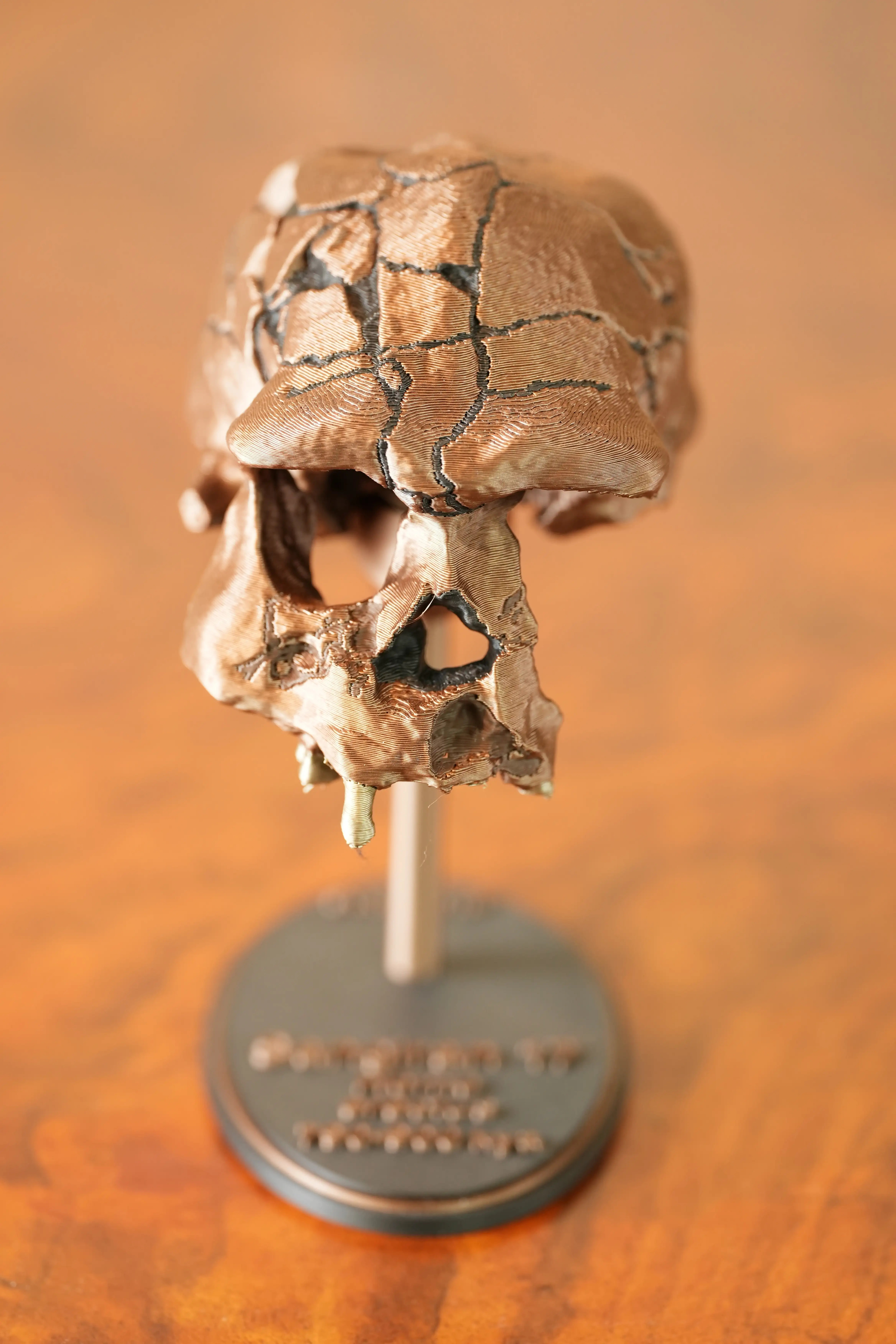
In 1969, a villager named Towikromo pulled a skull from river deposits near Pucung in Central Java. Dated to roughly 800,000 years ago, it was the most complete Homo erectus ever found in Asia—and the only one preserving a face.
The Sangiran site, now a UNESCO World Heritage location, has yielded over 100 H. erectus individuals, more than any other site in the world. But it has also attracted fossil thieves: in 2010, an American was arrested nearby with $2 million worth of stolen specimens.
Why Sangiran 17 Matters
Before Sangiran 17, reconstructing an Asian H. erectus face required guesswork. This skull—with its intact cheekbones, brow ridges, and right dentition—became the global reference. Replicas sit in major museums worldwide.
With a cranial capacity around 1,000 cc, Sangiran 17 belongs to the "large-brained" group of Javanese H. erectus, showing that brain size in this species varied considerably across time and geography.
Homo erectus Context
H. erectus was the first hominin to leave Africa, dispersing into Asia by 1.8 million years ago. They were also the first with human-like body proportions—shorter arms, longer legs, built for distance travel. Their tenure lasted over 1.7 million years, making them the longest-surviving human species.
In Java, H. erectus used freshwater shell flakes as tools and lived along rivers rich in mollusks, fish, and turtles. The population persisted remarkably late: fossils from Ngandong date to just 117,000–108,000 years ago.
Open Questions
Did Javanese H. erectus encounter modern humans? The timing is close. Why did this population develop unique skull features—an elongated cranial base, distinctive muscle attachments—not seen elsewhere? And why, after nearly two million years of success, did they finally disappear when Java's climate shifted from grassland to rainforest?