
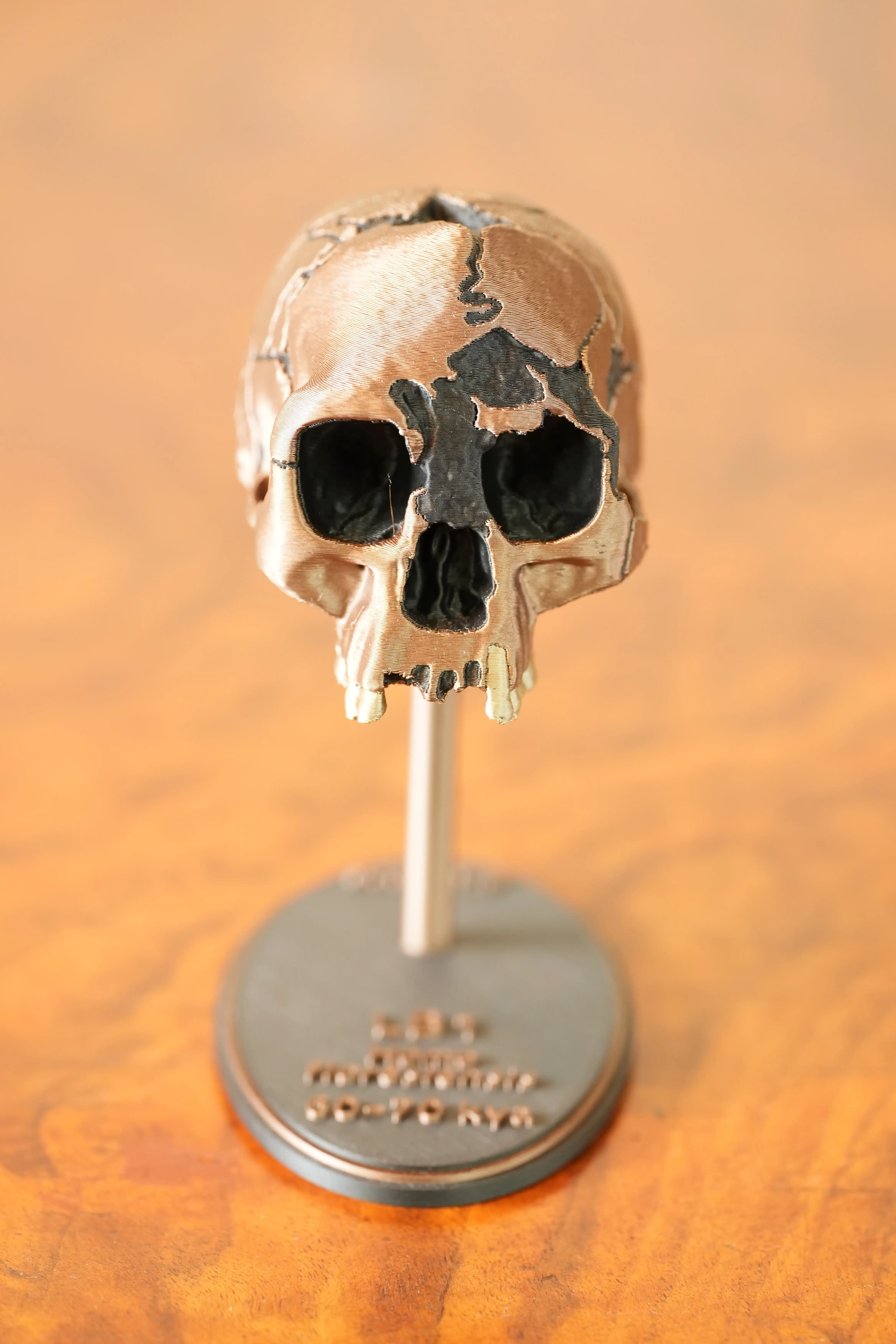
Discovery
In 2003, a joint Australian-Indonesian team uncovered a partial skeleton in Liang Bua cave on Flores, Indonesia. The bones were so small researchers assumed they belonged to a child until tooth wear and skull sutures revealed an adult woman in her thirties. Standing just over a meter tall with a brain the size of a chimpanzee's, she became the holotype for Homo floresiensis, nicknamed "the Hobbit."
The discovery sparked controversy. Indonesian paleoanthropologist Teuku Jacob removed the fossils without permission and declared them a diseased modern human. When he returned them months later, the pelvis was smashed, the jaw bore deep knife cuts, and a chin had been snapped off and glued back together.
Why LB1 Matters
LB1 is the most complete H. floresiensis specimen. Its combination of traits, an archaic skull on a body with feet and limb proportions resembling Australopithecus, challenged assumptions about hominin evolution. The brain, at roughly 420 cc, seemed impossibly small for a toolmaker.
H. floresiensis Context
The island of Flores was never connected to the mainland. Reaching it required crossing at least 24 kilometers of open water, and it is unknown how the ancestors of H. floresiensis arrived. Once isolated, they shrank fast: fossils from Mata Menge, 700,000 years old, are even smaller than LB1. Despite brains one-third our size, they made stone tools and hunted stegodons twice their weight. As the brain shrank, it didn't shrink evenly. Prefrontal regions for planning and decision-making appear to have stayed near-human size.
Open Questions
How did a pre-boat hominin cross open ocean? Why did their toolmaking stay unchanged for 700,000 years while their bodies transformed? They disappeared around 50,000 years ago, alongside the stegodons they hunted, during a severe drought that cut rainfall by a third. Modern humans arrived in the region around the same time. Competition, climate, or both?