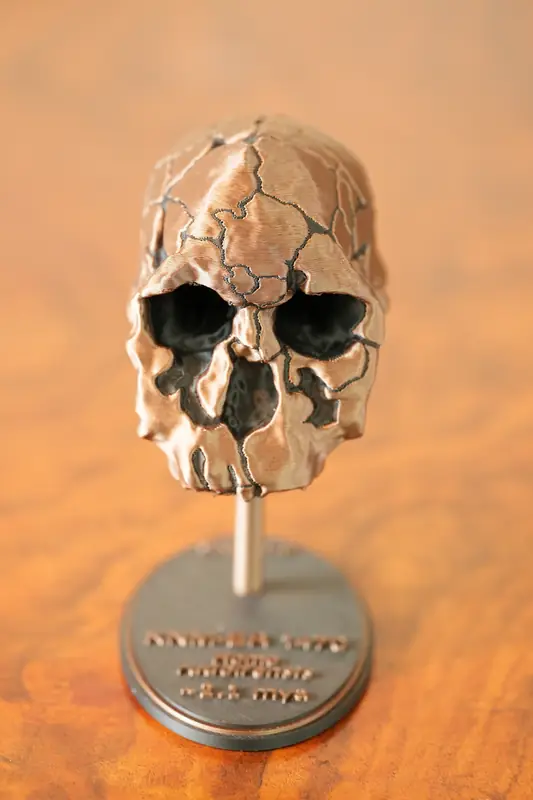
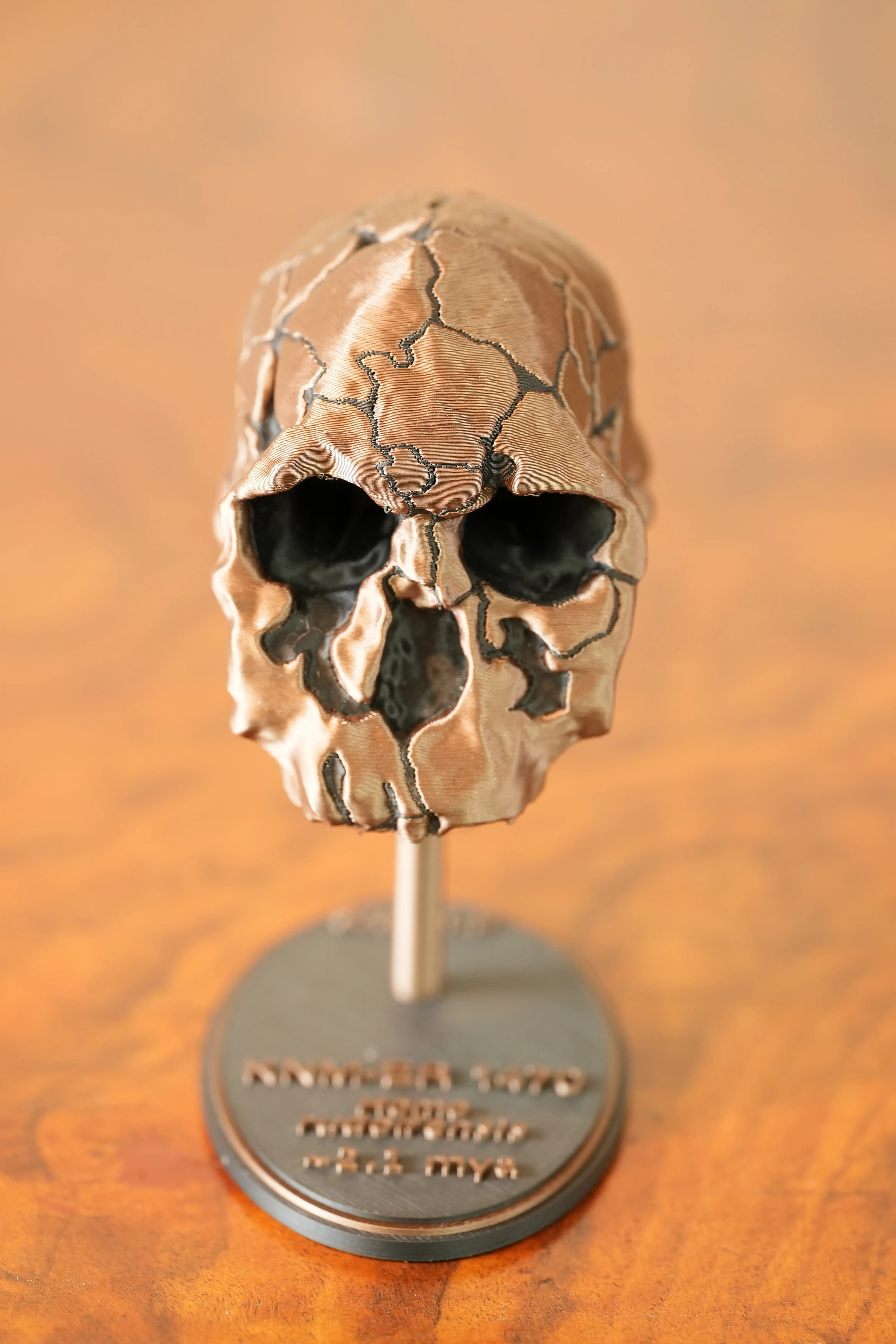
Discovery
In 1972, Bernard Ngeneo found skull fragments at Koobi Fora, Kenya, during a Leakey family expedition. Richard Leakey led the fieldwork, and his wife Meave helped Bernard Wood reconstruct 150+ pieces into a large, flat-faced cranium.
Richard's father Louis saw the skull just days before his death. Believing it to be 3 million years old (a million years older than it actually was), he called it an "indeterminate species of Homo" and died without resolving its identity.
Why KNM-ER 1470 Matters
At ~750 cc, the brain is large for early Homo. More striking: it shows a modern humanlike Broca's region expanded on the left side, suggesting language capability and handedness—the oldest undisputed evidence of such anatomy.
The skull forced the field to confront diversity in early Homo. KNM-ER 1813, another Koobi Fora skull of similar age, looks nothing like it—too different to be sexual dimorphism unless early Homo was more dimorphic than gorillas.
Homo rudolfensis Context
Koobi Fora ~2 Ma was a mosaic of grasslands, woodlands, and lakeside wetlands. Hominins butchered bovids, hippos, and catfish with Oldowan tools, and at nearby FwJj20, cut marks outnumber carnivore tooth marks, evidence of active butchery rather than scavenging. Isotope data shows early Homo ate ~65% C3 foods (fruits, leaves, forest resources) and ~35% C4 (grasses, sedges), a more mixed diet than Paranthropus.
Open Questions
New fossils from 2012 (KNM-ER 62000, 60000) closely match 1470, confirming rudolfensis as a distinct species, not just one anomalous skull. But its place in our ancestry is unclear. Cladistic analyses suggest it shares more features with australopiths than with later Homo, making it possibly a side branch, not an ancestor. Some researchers argue it doesn't belong in genus Homo at all.