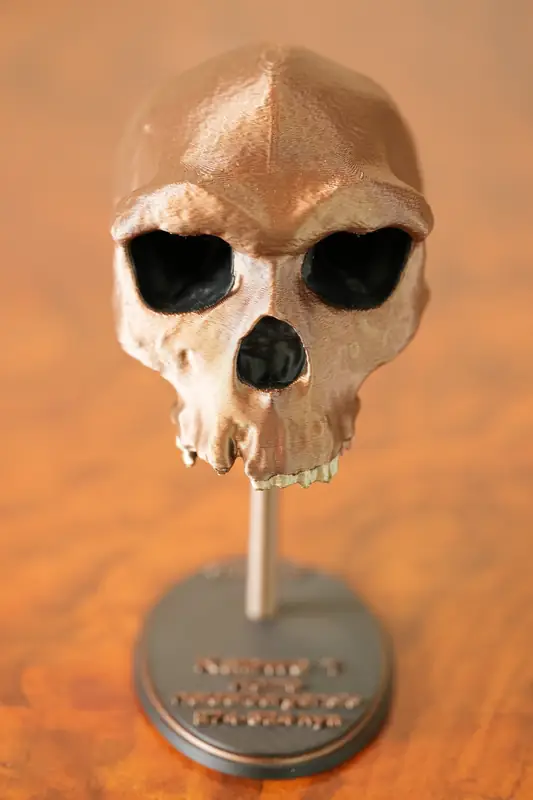
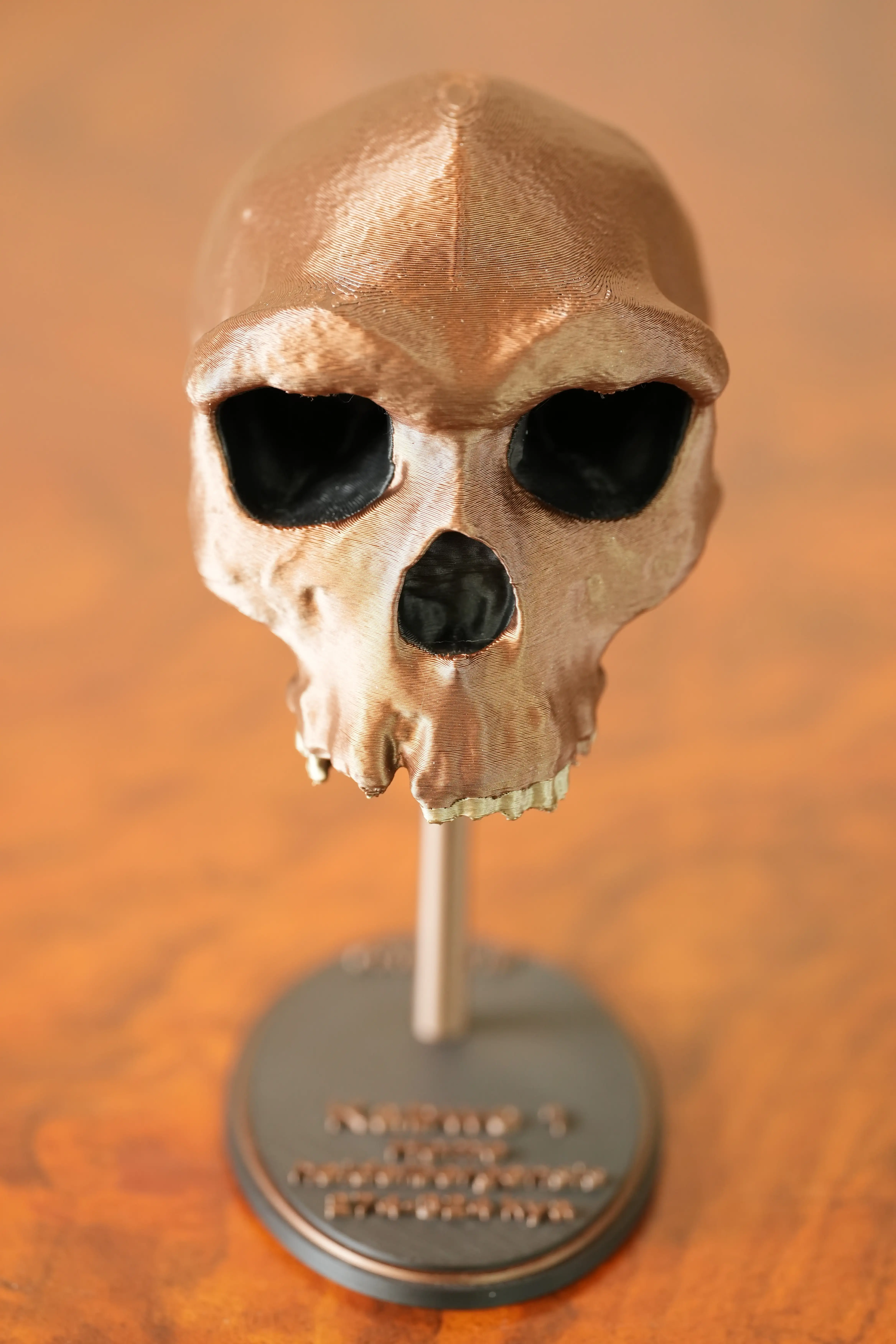
Discovery
In June 1921, Swiss miner Tom Zwiglaar and an unnamed Black worker struck a skull with a pickaxe 24 meters down in a cave at Broken Hill mine, Northern Rhodesia (now Zambia). It was the first significant human fossil found in Africa. Beneath it lay what looked like a rolled hide—probably mineralized bone—which went into the smelter before anyone understood what they had.
The mining company shipped the skull to London, where Arthur Smith Woodward named it Homo rhodesiensis. Zambia has sought its return since 1972. Over fifty years of negotiations have failed; the skull remains in the Natural History Museum.
Why Kabwe 1 Matters
The skull preserves an extraordinary face: massive brow ridges, a sloping forehead, yet a braincase of 1,300 cubic centimeters, within modern range. It sits morphologically between Homo erectus and us.
More striking is the pathology. Ten of sixteen teeth have cavities, with abscesses and exposed pulp chambers—remarkable for the Pleistocene, when dental disease was rare. Lesions on the temporal bone suggest chronic ear infection. The individual may have died from systemic infection.
H. heidelbergensis Context
Most researchers now assign Kabwe 1 to H. heidelbergensis, a species found across Africa and Europe from roughly 700,000 to 200,000 years ago. They produced refined Acheulean handaxes, hafted stone points, and controlled fire. Some consider them ancestral to both Homo sapiens and Neanderthals.
Open Questions
H. heidelbergensis was long considered the last common ancestor of Neanderthals, Denisovans, and us. However, recent genetics complicate this. The taxonomy itself is contested. In 2022, Roksandic et al. proposed abandoning H. heidelbergensis as hopelessly muddled and replacing it with H. bodoensis for African specimens. Critics counter that reshuffling names doesn't resolve the phylogenetic confusion.
Direct dating in 2020 added another wrinkle: Kabwe 1 is only about 300,000 years old—contemporaneous with early H. sapiens in Morocco. The honest answer is that we don't have a clear fossil candidate for the last common ancestor. It may be a million years old and still in the ground.